Every venue looks incredible on its own website. That’s the trap. Those photos were shot by a professional, at the best hour of the best day, from the three angles that work. What you actually want to know is different: will this place look good in your photos, taken at your ceremony time, when it’s raining, and after the sun goes down?
A rustic wedding venue in Indiana has a real head start on that question, but not for the reason most people assume. It’s not that barns are automatically photogenic. It’s that a good one gives your photographer options, and options are what separate a beautiful gallery from a repetitive one.
We’re the team at Sunflower Hills Historic Barn Venue in Bryant, Indiana, and we’ve watched a lot of photographers work our 1911 barn. Here’s what actually matters, from that vantage point.
The real test is how many different photos one place can give you
A wedding photographer needs variety, because your album tells the story of a whole day. Getting ready, the ceremony, portraits, the reception, the exit. If every one of those happens against the same wall, your gallery feels like it was shot in an afternoon, because it was.
So the question to ask any venue isn’t “is it pretty?” It’s “how many genuinely different backgrounds can I get here without driving somewhere else?” A strong venue gives you four or five: an exterior, an open outdoor space, a bright getting-ready room, the reception interior, and something for after dark.
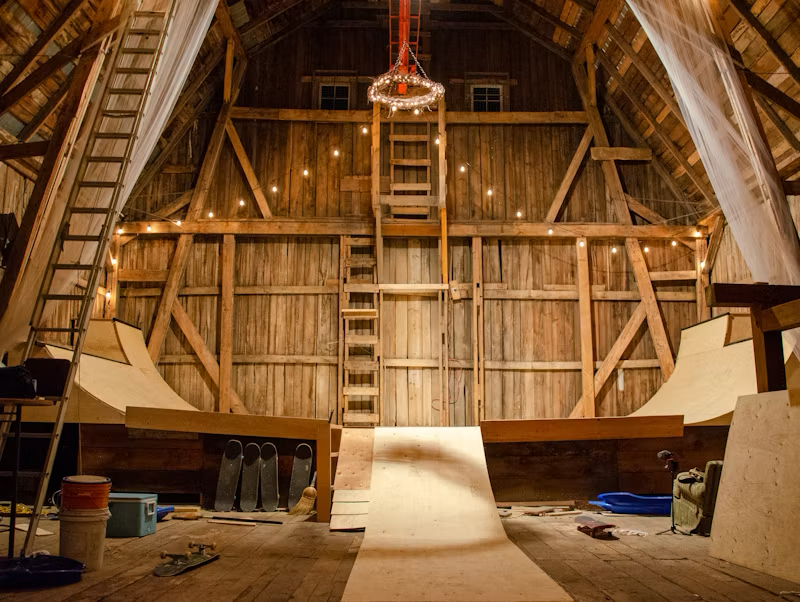
This is the quiet advantage of a restored historic barn. The weathered exterior is one look. The interior with its beams is a completely different one. Add an outdoor space and evening lighting, and you’ve got range built into a single property.
Why old wood photographs better than new construction
Here’s something photographers know that couples usually don’t. A newly built “barn rustic venue” and a genuinely old barn photograph differently, and the camera catches it even when your eye doesn’t.
Original century-old wood has irregularity. The grain, the joins, the way the boards have aged unevenly. All of it reads as texture and depth in a photo. A manufactured barn built last year to look old tends to photograph flat, because it is flat. It’s uniform in a way real age never is.
Our barn was built in 1911, and the beams in your photos are the actual structure, not a decorative overlay. That authenticity is subtle in person and obvious in a good portrait. It’s the difference between a background and a backdrop with a story.
Light is the whole game, and rustic venues can go either way
This is where I’ll push back on the idea that rustic automatically means good photos. It doesn’t. Plenty of barns are dark caves with a few bulbs, and dark is the enemy of a good photograph.
What you want is a venue that solves light in two directions. During the day, you want big doors or windows pulling in soft natural light, because that’s the most flattering light there is and it’s free. After sunset, you want warm, controllable interior lighting, because once the natural light is gone, harsh overhead bulbs will wreck every reception photo.
The two-part answer at our place is the barn doors for daytime and adjustable rafter lighting with twinkle accents for the evening. That second part matters more than it sounds. Being able to dim the room as the night goes on means your reception and dance-floor photos keep that warm glow instead of going flat and yellow. When you tour any venue, ask specifically: can the lighting be dimmed? A flat “no” is a real mark against the place for photos.
The backup plan is a photo feature, not an afterthought
Nobody wants to think about rain. But in Indiana, you plan for it, or you gamble. And here’s the part couples miss: a good covered space isn’t just insurance; it’s often a great photo location in its own right.
A barn interior means your portraits happen regardless of the sky: no frantic relocation, no washed-out gray light, no cancelled couple session. The shoot moves inside and keeps its character, because the character is in the building, not the weather.
That’s genuinely one of the strongest arguments for a rustic venue over a purely outdoor one. The outdoor spot is Plan A, and it’s gorgeous. But you always have Plan B under the same roof, and Plan B still looks like your wedding.
How to actually plan your photos around the venue
Booking the right place is half of it. Here’s how to make sure you use it well.
Scout it with your photographer before the day. This is the single most valuable thing you can do, and it’s where our setup structure quietly helps. Our two-day rental includes Friday from 3 to 7 PM. Beyond decorating, that window lets your photographer walk the property in advance and plan every shot, so Saturday isn’t spent hunting for angles.
Find out when golden hour lands in your month. That hour before sunset is the best light you’ll get all day, and it moves. An October sunset in Indiana comes hours earlier than a June one. Build your portrait time around it rather than fighting the schedule later.
Give portraits enough runway. Budget about 45 minutes for the two of you and another 30 for family groupings. A venue with a long rental window makes this stress-free instead of a sprint. Ours runs Saturday until 11:30 PM, so there’s room for a proper session and a night exit.
The bottom line
A rustic wedding venue in Indiana is a strong photo choice when it does three things: gives your photographer several distinct settings, solves light for both day and night, and keeps a covered backup that still looks like your wedding. Pretty exteriors are easy. That combination is what actually fills a beautiful gallery.
If you want to see whether a place delivers on all three, the only real way is to stand in it. Walk Sunflower Hills, ideally at the time of day you’re planning to marry, so you see the real light. Call (260) 433-4734 or schedule a tour.
FAQs
Are rustic barn wedding venues actually good for photos?
The good ones are, but it’s not automatic. What you want is genuine architectural character, several distinct backdrops, and lighting that works both in daylight and after dark. A dark barn with no natural light and no dimmable fixtures will fight your photographer all night, so tour with light in mind.
Can I have my photographer scout the venue before the wedding?
Most venues allow it, though few build it into the rental. It’s worth arranging, because a photographer who has already walked the space plans better shots and wastes no time on the day. Our Friday 3 to 7 PM window doubles as scouting time for exactly this reason.
What's the most important thing to check for wedding photos when touring?
Ask whether the interior lighting can be dimmed, and look at how much natural light comes in during the day. Those two answers predict your reception and portrait photos more than anything else. A venue that nails both, with some real architectural character, is set up to give you a strong gallery.
What makes a wedding venue "rustic" and good for photos?
A rustic venue typically features natural materials like exposed wood beams, barn wood, stone, and greenery, often set on a farm or countryside property. These textures pair beautifully with natural light, giving photos a warm, timeless look without needing much extra decor.
What time of day gives the best wedding photos at a rustic venue?
Golden hour, roughly 60–90 minutes before sunset, gives the softest, most flattering light for outdoor rustic portraits. Many couples build a dedicated 20–30 minute window into their timeline right after the ceremony to capture this light.
Do rustic venues in Indiana offer both indoor and outdoor photo spots?
Most rustic Indiana venues offer a mix of indoor barn interiors and outdoor farmland, gardens, or tree lines, giving photographers variety across lighting conditions. This flexibility is helpful if weather changes or if you want both bright, airy shots and moody indoor barn shots in one gallery.